

Gujarat: The First State in India with a Dedicated Semiconductor Policy for Holistic Sectoral Support
A Comprehensive Semiconductor Ecosystem Rapidly Taking Shape in Gujarat with Supporting and Ancillary Industries
Gandhinagar, 4 July : Semiconductor chips are at the heart of modern technology, powering everything from smartphones and electric vehicles to advanced defence systems. As a strategically important sector in the global technology landscape, the semiconductor industry is vital for strengthening a nation’s technological and economic capabilities. Guided by Prime Minister Shri Narendra Modi’s vision of building an Aatmanirbhar Bharat through the ‘ Make in India’ initiative, the Government of India launched the India Semiconductor Mission (ISM) to establish a robust domestic semiconductor ecosystem. The mission aims to strengthen semiconductor (chip) and display manufacturing in the country while reducing dependence on imports.
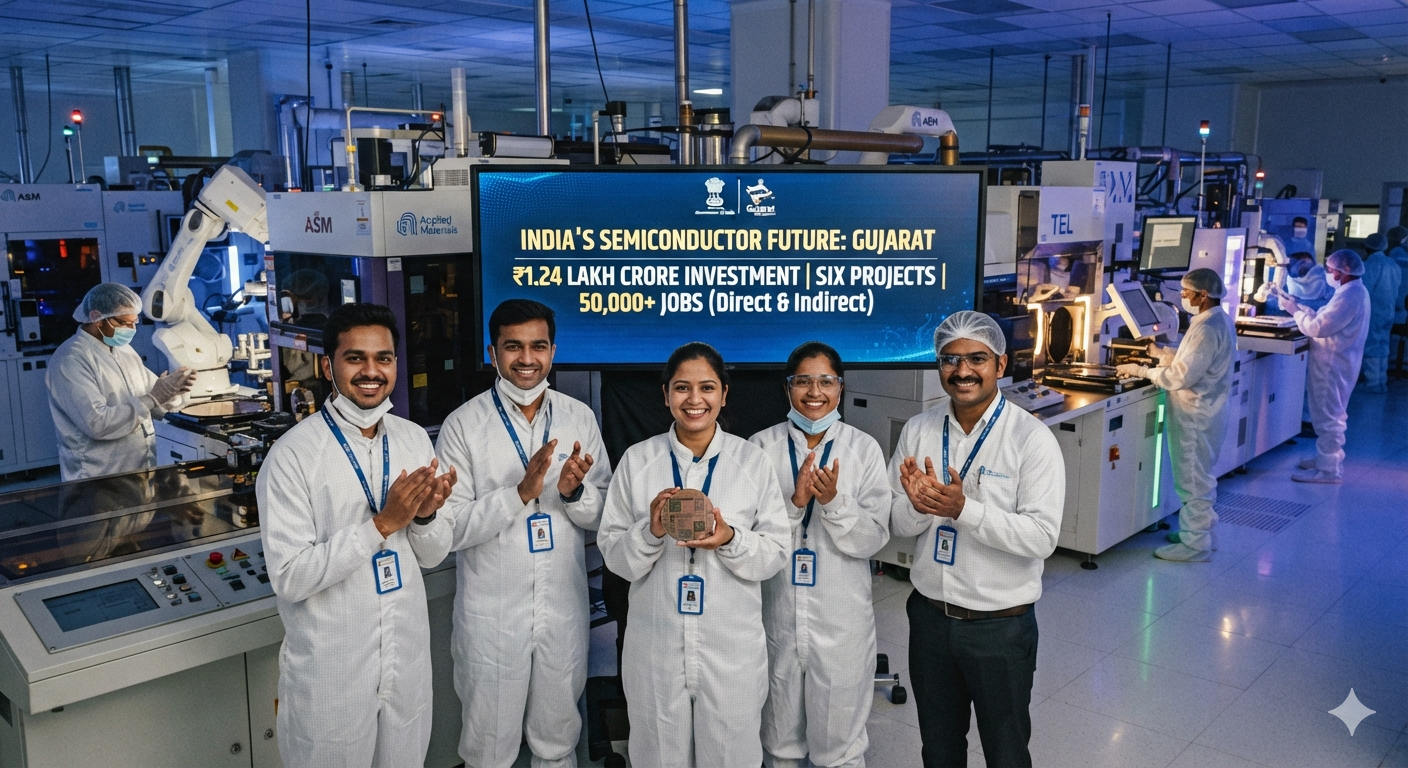
Aligned with this vision, Gujarat has emerged as India’s leading semiconductor hub. Under the leadership of Chief Minister Shri Bhupendra Patel, Gujarat became the first state in the country to introduce a dedicated semiconductor policy, offering holistic support to the sector. Under the India Semiconductor Mission, six major semiconductor projects have been approved in the state, with a combined investment of about ₹1.24 lakh crore. These projects are expected to generate over 50,000 direct and indirect employment opportunities, significantly strengthening India’s semiconductor manufacturing capabilities and accelerating the country’s journey towards self-reliance in this strategically important sector.
Semiconductor Plants of Micron Technology, Kaynes Semicon Are Operational in Gujarat; Others to Start Soon
The six semiconductor projects approved in Gujarat under the India Semiconductor Mission include Tata Electronics, Micron Technology, CG Power & Industrial Solutions, Kaynes Semicon, Suchi Semicon and Crystal Matrix. Several of these projects have already made significant progress. Micron Technology and Kaynes Semicon have established their OSAT (Outsourced Semiconductor Assembly and Test) facilities at Sanand GIDC. The Micron Technology and Kaynes Semicon plants were inaugurated by Prime Minister Shri Narendra Modi in February and March this year, respectively, and are now fully operational. Further strengthening Gujarat’s semiconductor manufacturing ecosystem, CG Semi will begin commercial production at its OSAT facility from tomorrow, i.e. 4th July. This marks another significant milestone in Gujarat’s journey towards becoming India’s leading semiconductor hub.
Suchi Semicon’s OSAT pilot plant is already operational in Surat, contributing to the growth of India’s semiconductor packaging and testing capabilities. The company’s OSAT facility has also been approved under the India Semiconductor Mission. Tata Electronics’ semiconductor fabrication (Fab) facility at Dholera is in its advanced stage of construction and is set to become India’s first commercial semiconductor foundry. Additionally, Crystal Matrix has been approved under the India Semiconductor Mission to establish the country’s first commercial mini and micro-LED display fabrication and packaging unit. Construction of this project is expected to begin shortly at Dholera SIR. Together, these projects position Gujarat at the forefront of India’s efforts to build a resilient and globally competitive semiconductor value chain, spanning fabrication, assembly, packaging, testing, and advanced electronics manufacturing.
Semiconductor Ecosystem is Shaping up in Gujarat
In addition to the approved semiconductor projects, a broader semiconductor ecosystem is rapidly shaping up in Gujarat through the growth of supporting industries and allied infrastructure. Several global and domestic companies have already established operations in the state or announced plans to do so, including Linde, Taiwan’s TSMT, Japan’s TNSI, Fujifilm, Nippon Express, Germany’s Infineon Technologies, Malaysia’s Hotayi, among others. Their presence is helping create an integrated semiconductor cluster capable of supporting large-scale fabrication and packaging work.
The Gujarat Electronics Policy, aligned with the Government of India’s SPECS (Scheme for Promotion of Electronic Components and Semiconductors) , further strengthens this ecosystem by supporting the entire value chain of semiconductor and electronics manufacturing. This includes component manufacturing, semiconductor fabrication, packaging and testing facilities, as well as material suppliers, equipment providers, and manufacturers of ultra-high purity gases and speciality chemicals required for the sector.
Notably, the Union Finance Ministry has recently approved an outlay of ₹1.25 lakh crore for ISM 2.0, which is expected to be placed before the Union Cabinet for final approval. This will further deepen India’s semiconductor capabilities and accelerate sectoral growth. Through financial incentives, infrastructure support, ease of doing business initiatives, ecosystem-building measures, and transparent governance, Gujarat aims to emerge as a globally competitive semiconductor hub, contributing significantly to the objectives of the National Semiconductor Mission.
